In today’s professional baking landscape, the choice between sourdough and commercial yeast isn’t just about flavour — it directly impacts texture, dough handling, shelf life, product positioning, and consumer perception. As demand for clean-label and artisan-style baked goods continues to grow across hotels, QSRs, and industrial bakeries, understanding the functional differences between sourdough and yeast becomes essential.
In this article, we break down how each fermentation method works, what it delivers to your product, and why modern bakers are increasingly choosing to blend or replace commercial yeast with dehydrated sourdough like le’sourdo® for superior results.
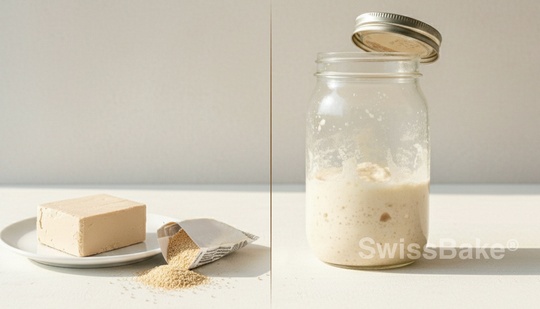
Commercial yeast, commonly Saccharomyces cerevisiae, is a single-strain organism cultivated for rapid and consistent gas production. It is used to leaven doughs in shorter timelines, usually under 2–3 hours, with high predictability and yield.
Sourdough fermentation is a symbiotic culture of wild yeasts and lactic acid bacteria (LAB). Unlike commercial yeast, sourdough organisms ferment sugars more slowly and produce organic acids, ethanol, carbon dioxide, and flavor compounds, contributing to enhanced product characteristics beyond leavening.
• Fast-acting, requires short bulk proofing times (1–2 hours)
• Ideal for high-volume, fast-paced production
• Consistent rise but lower tolerance for long fermentation or cold storage
• Minimal flavour complexity
• Requires longer fermentation (12–24 hours)
• Supports cold fermentation, retardation, and bulk aging
• Enhances gluten structure and crumb integrity
• Results in more complex flavour profiles and enhanced aroma
Functional Insight: Sourdough fermentation allows for extended enzyme activity, enhancing dough extensibility and improving final bake volume in artisan formats.
• Uniform gas cell distribution
• Softer crumb in white breads
• Less chew and bite in rustic loaves
• Irregular, open crumb (ideal for ciabatta, baguettes)
• Better water absorption and moisture retention
• Enhanced chew and bite, especially in rye or wholegrain formulations
Functional Insight: The acidity from sourdough stabilizes amylase activity, reducing gumminess and promoting crumb elasticity, especially in high-hydration doughs.
• Produces ethanol and CO2
• No significant antimicrobial action
• Produces lactic and acetic acids
• Naturally inhibits spoilage organisms like mould
• Extends shelf life without added preservatives
Functional Insight: Sourdough acts as a natural preservative, allowing bakers to formulate longer-shelf-life products under clean-label or additive-free guidelines.
• Mild, sweet notes
• Low aroma complexity
• No tang or fermented depth
• Tangy, aromatic, with depth of flavour
• Nutty, malty, or earthy notes depending on the starter
• Improves crust colour and caramelization
Functional Insight: Sourdough enhances Maillard reactions, leading to darker crusts, appealing textures, and stronger aroma profiles — ideal for gourmet breads and premium bakery lines.
• Shelf-stable and easy to store
• Integrates easily into standard production processes
• Best for high-speed industrial lines
• Traditionally time-consuming and complex to manage
• But with dehydrated sourdough powders like le’sourdo®, you gain:
– Starter-free simplicity
– Consistent dosage and effect
– Clean-label positioning with artisan storytelling
Functional Insight: Using le’sourdo® powders bridges the gap between traditional fermentation benefits and commercial practicality — without disrupting existing production lines.
Rise Time
• Commercial Yeast: Fast
• Sourdough (le’sourdo®): Slow, controlled
Flavour Development
• Commercial Yeast: Mild
• Sourdough (le’sourdo®): Rich, complex
Crumb Structure
• Commercial Yeast: Even and uniform
• Sourdough (le’sourdo®): Open, artisanal
Moisture Retention
• Commercial Yeast: Moderate
• Sourdough (le’sourdo®): Excellent
Shelf Life Extension
• Commercial Yeast: Limited
• Sourdough (le’sourdo®): Extended (due to natural organic acids)
Preservative-Free Advantage
• Commercial Yeast: Low
• Sourdough (le’sourdo®): High — naturally preserved through fermentation
Artisan Appeal
• Commercial Yeast: Low
• Sourdough (le’sourdo®): High
Clean-Label Compatibility
• Commercial Yeast: Moderate
• Sourdough (le’sourdo®): Excellent
Today’s consumers expect more than just “freshly baked.” They want authenticity, flavour depth, and better-for-you choices. At the same time, bakers need scalable, efficient solutions.
This is why chefs and manufacturers are:
• Replacing yeast entirely in slow-ferment or signature recipes
• Blending 2–5% sourdough powder with yeast for added tang and crust enhancement
• Enhancing frozen or par-baked SKUs with sourdough for better thawed texture
• Using sourdough in vegetarian and clean-label baking to improve mouthfeel and structure
• Artisan Breads: Replace or blend yeast with le’sourdo® for rustic crust and chewy crumb
• Frozen Pizza Bases: Add 5–10% le’sourdo® for acidity and aroma post-thaw
• Burger Buns / Rolls: Enhance softness, shelf life, and structure using sourdough + yeast
• Pastries & Crackers: Improve eating quality without altering process flow
• Multigrain or Rye: Balance density and increase fermentation efficiency
While commercial yeast remains a practical leavening solution for many applications, its limitations in flavour, preservation, and artisan value are increasingly evident. On the other hand, sourdough fermentation — especially in its modern, powdered form via le’sourdo® — provides unmatched benefits across structure, shelf life, flavour, and clean-label formulation.
Whether you're producing 100 baguettes a day or 100,000 burger buns a week, sourdough is no longer just an artisan ingredient — it’s a functional, brandable baking asset.
Explore the full le’sourdo® range at www.lesourdo.com